
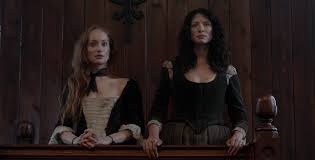

Accusations of witchcraft have been used for centuries as a means of committing violent crimes against women who do not confirm to the expectations which society demands of their gender. The various laws and proofs surrounding witchcraft “practices” are geared in such a way that, should she fall victim to an accusation, a woman is virtually assured of being murdered for her crimes. Not only will this murder be painful and drawn out, but public and capitalized upon as both entertainment for the masses and a warning to other women within the community. In the case of Geillis Duncan and Claire Fraser, adherence to gender roles within the context of the social order, along with the surrender of autonomy, are ongoing battles which neither woman is willing to surrender in. This chapter looks at the use of the accusation of witchcraft in the Outlander series, with a focus on Geillis and Claire and how their experiences of being accused of witchcraft, and put on trial for it, function as part of a larger historical narrative on control and oppression.
Drawing on historical accounts of witchcraft trials, particularly from Scotland and the larger United Kingdom, my argument examines the historical accuracy of Geillis and Claire’s experiences, with a view towards how their role as independent and educated women ultimately leads to their indictment by the community and subsequent trial. The “crimes” for which they are accused, along with the punishments that are threatened will similarly be explored with a focus on how the use of extreme physical violence and death are employed as a form of coercion and control within the series, as they have been throughout history.
Though both Geillis and Claire could be described as witches, to the extent that both are openly engaged in the use of herbal remedies to cure and prevent illness within their village, this practice only becomes problematic when they run afoul of other women. What this dynamic also illustrates is how women often function as perpetrators of crime against other women, an action which generally occurs in response to an attempt to protect one’s own fragile sense of social security and status in a society where either can be removed in an instant. When we consider the trial and punishment of Geillis and Claire from this viewpoint, we see also the comment which Outlander makes around the precarious nature of womanhood and feminine identity in society. How much that precarity has changed between the historic setting of the Scottish Highlands and the contemporary world remains to be seen.

 Racheal writes